

Your staff and your AI agents, working one system.
Retavon is business software for specialty retailers: point of sale, inventory, delivery, service and the books. People work it on screen. AI agents work the same records through the same API, with only the permissions you give them, and every change lands in one audit trail.
One work order, two ways in
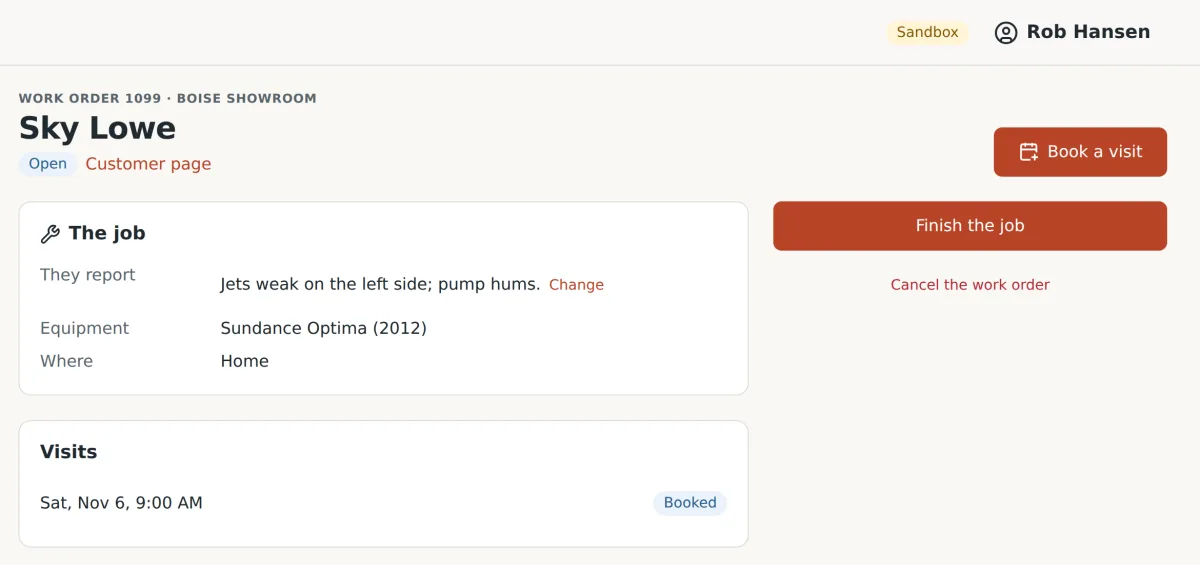
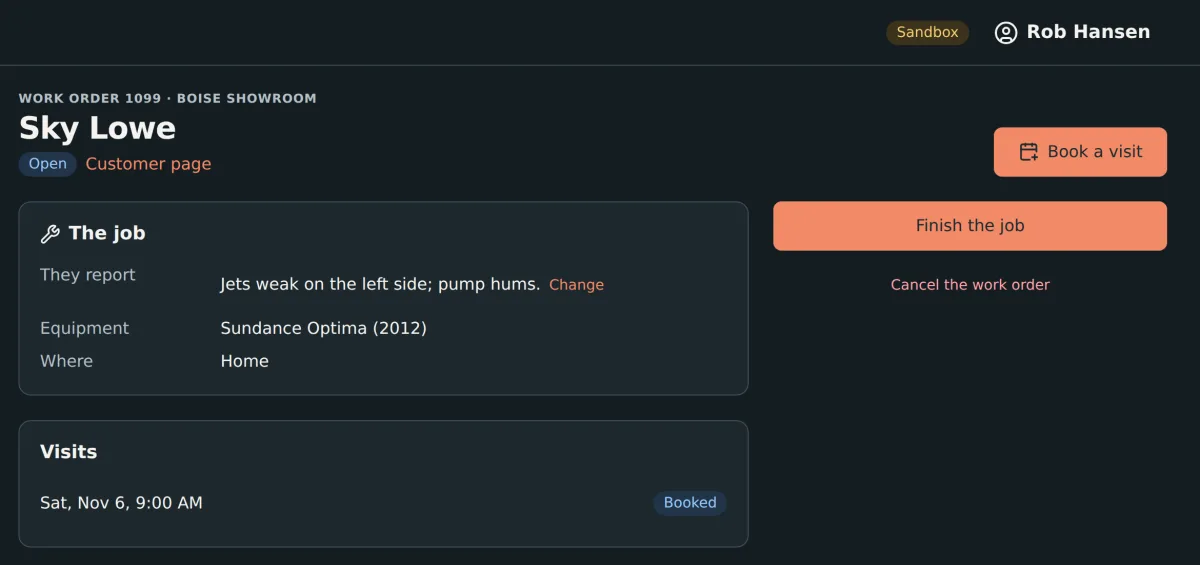
Work order 1099 is open. Your service manager sees it on screen. An agent asks the API for the same record and gets the same choices, each with the reason it applies.
{
  "work_order_number": 1099,
  "status": "open",
  "customer_name": "Sky Lowe",
  "location_name": "Boise Showroom",
  "problem": "Jets weak on the left side; pump hums.",
  "next": [
    { "operation_id": "addWorkOrderCharges",
      "why": "Charge parts and labor, on a new sales order for this job." },
    { "operation_id": "completeWorkOrder",
      "why": "Record what was done and close the job." },
    { "operation_id": "cancelWorkOrder",
      "why": "The work will not be done." }
  ]
}| On screen, for a person | In the API, for an agent |
|---|---|
| Finish the job | completeWorkOrder |
| Cancel the work order | cancelWorkOrder |
Screen and response from Retavon's staging sandbox, which holds made-up customers. The response is shortened to the fields shown; each next step also carries its method and path.
Two ways in, one set of rules
The web app is a client of the same API your agents call. A person and an agent see the same records, are refused the same things, and leave the same trail.
For the people in your stores
Screens built around the job in front of someone: a ticket at the counter, the day's routes for a dispatcher, a technician's visits on their phone. Each person sees only what they may do, and at a shared counter a manager approves a refund or a return with their PIN on the same screen.
Shared counter computers switch between staff by PIN. Field screens keep what a technician entered when the signal drops and send it once when it returns.
For the agents you put to work
Give an agent a key that acts for a person and holds exactly what they hold, or a key with roles of its own. Make it read-only if it should only look. Keys expire, and you can rotate or revoke them from the settings screen.
Everything an agent does is in the audit trail under its key's name, next to the work your staff do.
From the first quote to the tenth service call
Built for retailers who sell substantial things, then deliver, install and look after them. One system holds the customer, the unit, the money and the next visit.
Counter and sales
Quotes that become orders, and counter tickets for the small stuff.
- Packages, price lists, trade-ins, layaways and gift cards
- Deposits held until hand-over, when the sale counts
- Commission split between salespeople
Inventory and purchasing
Every serialized unit tracked from the purchase order to the customer's home.
- FIFO or average cost, your choice
- Counts by scanning, transfers between stores, par levels for vans
- Special orders tied to the customer, landed cost, returns to vendor
Delivery and install
A queue of what is ready to go, and routes your dispatcher puts in order.
- Site checks, and outside parties like a crane or an electrician
- Proof of delivery with signature and photos
- A failed delivery records why, and can charge a redelivery fee
Service
Work orders against the customer's own equipment and its warranties.
- Open jobs oldest first, each saying whether a visit is booked
- A technician's day on their phone: timers, parts from the van, checklists, photos
- Customer sign-off, and labor billed by your rounding rules
Money and the books
Every event that moves money or stock posts a balanced journal entry as it happens.
- Cash drawers with blind counts, the safe and bank deposits
- House accounts, statements and consumer financing
- QuickBooks stays your book of record
The owner's view
Numbers read live from the books, store by store, against the same weekdays last year.
- Sales handed over, orders written, margin and service
- Day close, shrink and what customers owe
- A check that every rule about the books holds
An API written for the agent on the other end
An agent has only the API's description and its replies, and acts on every field. So each reply says what the agent can do next and each refusal says how to fix it.
Every record says what can happen next
A record with a status carries next: the operations its state allows, each with why. An agent does not have to guess the workflow.
Refusals say what to do
Errors carry a code, a plain explanation and the operation to call instead. This is what the API sends a request with no key:
{
  "code": "unauthenticated",
  "detail": "Send a valid API key in the Authorization header ...",
  "retryable": false,
  "next": [{ "operation_id": "signIn",
    "why": "Sign in with your business, email and password for a new session." }]
}
The numbers people quote work
Work order 1099, order 1042, a SKU, a store's code: where a record has a number people quote, the API takes that number in place of its id.
Money moves once
Writes that take money or move stock require an idempotency_key. An agent that retries after a dropped connection cannot take a deposit twice.
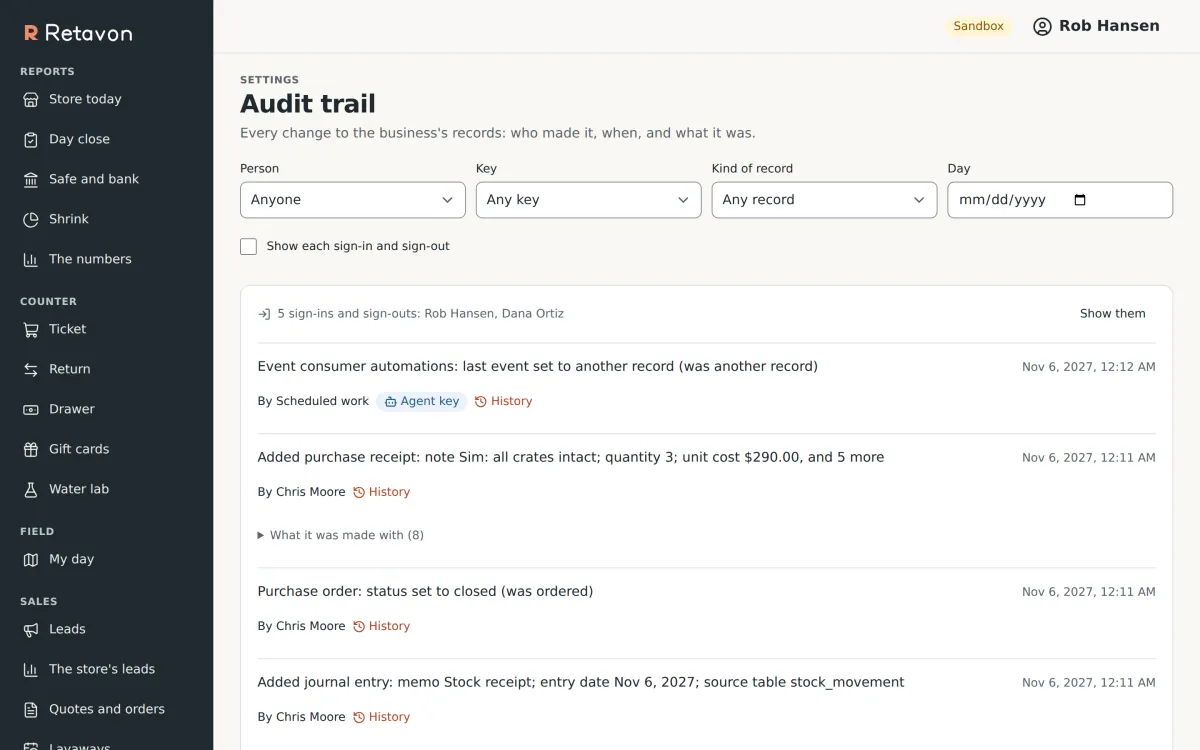
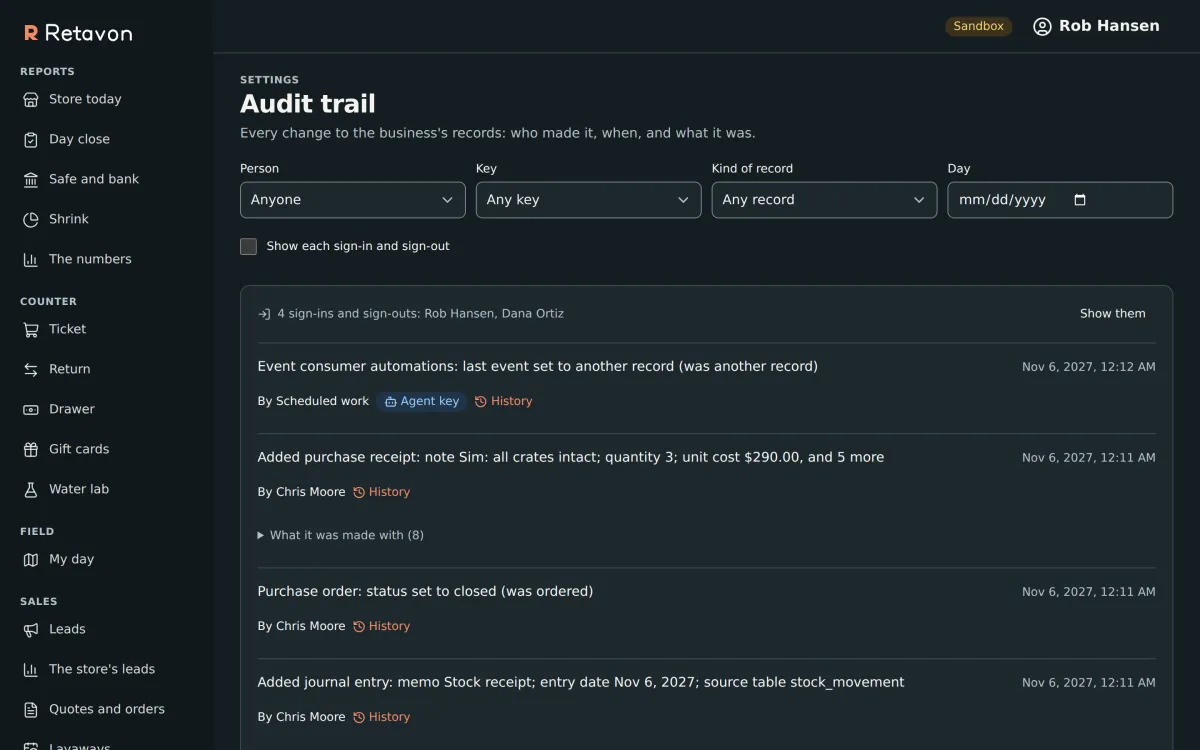
The audit trail lists an agent key's work, marked Agent key, beside the work of your staff. From the staging sandbox, whose clock has been moved ahead, so its dates read 2027.
Open beta for hot tub and spa dealers
Retavon is for any specialty retailer that sells, delivers and services what it sells. Hot tub and spa dealers come first, with the parts of the job only they have.
- Water testing at the counter or from a lab, with doses from your own rules and the pack to sell
- Packages of a spa with its cover, steps and delivery, at one price
- Serialized spas that become the customer's equipment once sold, ready for service
- Care plans for recurring service visits and supply shipments
- Floor-plan loans tracked unit by unit